By Hedy S. Wald
“Medicine was used for villainous ends during the Holocaust. The Holocaust was an enormous trauma inflicted on human dignity and the human person; medicine was implicated in crimes against humanity.” His Eminence Daniel Cardinal DiNardo, Archbishop of Galveston-Houston.1
January 27 is International Holocaust Remembrance Day, a day designated by the United Nations General Assembly resolution 60/7 in 2005 after a special session marking the 60th anniversary of the liberation of the Nazi concentration camps and the end of the Holocaust.2 In the words of Secretary General Ban-Ki Moon (2008), “The International Day in memory of the victims of the Holocaust is a day on which we must reassert our commitment to human rights… We must also go beyond remembrance, and make sure that new generations know this history. We must apply the lessons of the Holocaust to today’s world.”2
Read More »



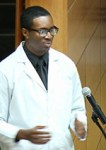 Good afternoon, my name is Kamaal Jones and I am a first year medical student here at Stritch. I first would like to briefly acknowledge all those involved in making today happen, specifically Chizelle Rush, who really took the lead in mobilizing and organizing us for this event. Today we, along with over 1000 medical students across the nation, are here to stand in solidarity with the recent protests which have captivated our country. For those who may lack some familiarity, these demonstrations have been born from a long history of issues with racial profiling and police violence in our society, and specifically, the grossly disproportionate levels at which the lives of Black and Brown people are taken by officers in this nation. The tipping point which has served as the catalyst for these most recent events was the August 9th killing of unarmed teenager Michael Brown by a police officer in Ferguson, Missouri, as well as the July 17th killing of an unarmed man named Eric Garner by an NYPD officer in Staten Island, NY. In both of these incidents, Grand Jury’s decided not to seek any charges against the officers…
 Reflective MedEd